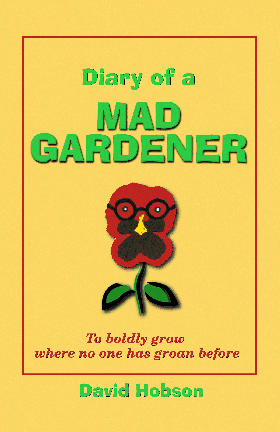
See
the book
January 6
It’s recycling day and the street is strewn with Christmas trees
waiting
for the recycling truck to collect them. Half the trees have the tinsel
still on them. It’s such a depressing sight. One moment they are
bringing
joy to the season, the next they are being tossed into the roadway. I’m
going to collect a few and drag them back to my place. I figure if I
jam
them into the flowerbed beside the driveway it will give my
micro-acreage
the look of a vast country estate with a tree-lined approach instead of
what it is: a plot that’s only big enough to support a pair of anorexic
goats.
January 7
I made a big mistake. Those Christmas trees have to go! They may look
lovely, but they are acting like a snow fence, a snow fence that is
perfectly
positioned to ensure my driveway is filled with snow every time the
wind
is from the west, and when the wind is from the east, it fills my
neighbour’s.
It must have been switching overnight because they’re both filled in
this
morning. I’ve had to spend all day clearing them and now I’m
exhausted.
I tried to pull out the trees but they’re frozen
solid, so there’s only
one thing for it—the chainsaw. Except chainsaws frighten me. Last time
I used a chainsaw was when I cut a new window into the shed and
shortened
the handle on my rake. I didn’t mean to shorten the handle. I didn’t
mean
to make the new window, either. I was cutting down an old lilac at the
time and, well, one thing led to another.
January 8
I don’t think I’ll be cutting down any trees for a while. After
yesterday’s
big snowstorm, I can’t see them anymore, and I’m not in the mood to go
looking for them, either. It’s wild out there. However, I did nip out
this
morning to pick up more potting soil, although I wish I hadn’t. My
local
garden centre had closed early, and I made the mistake of driving out
to
Bert’s Shrub n Grub (he sells burgers and fries at his nursery).
I bought six bags of potting soil from Bert, but when
I tried to drive
away the car lost traction on a patch of ice and I had to empty two of
them under the wheels to get me moving again. Seeing as it was Bert’s
parking
lot I was stuck in, I naturally went back in the store and asked for a
refund. He not only refused; he realized what was happening outside and
doubled the price, and what with so many cars spinning their wheels he
was soon raking in the cash. Come spring he’ll be raking in the potting
soil, re-bagging it, and selling it back to his customers as planter
mix.
I wasn’t going to pay his inflated prices, so I left,
but before I made
it across the parking lot the car got stuck again and I had to empty
another
bag. It took me another to get out onto the street, and then on the way
home I got stuck once more and had to use up the rest. I finally slid
into
my driveway with enough potting soil left to start a pair of petunias.
Dirt-cheap—Huh!
January 13
I feel I’m in need of some kind of winter distraction, so today I’m
planning to buy more seeds. However, before I go to the store, I must
prepare
carefully and make up a list of all the plants I’ve been lusting after.
I also have to settle on a fixed amount to spend, although I know from
experience it will be only a small percentage of what I actually spend.
I go through this every year and, as usual, when I get
to the store
the seeds I want aren’t on the shelf, and instead I come home laden
with
stuff that will germinate prolifically and put a strain on my plant
room’s
resources.
And of course, I will discover an overpriced packet of
something rare
and exotic that I can’t resist buying, a packet that contains just one
viable seed in a thousand that I’ll have to pamper like the last
emperor
until the end of summer. That happened last year, and on the day when
it
finally bloomed the neighbour’s cat showed up to anoint it.
January 14
As the tattered remnants of three seasons are calmed by the first
snowfall,
stillness comes to the garden. No shocks of colour craving attention,
no
heroic blossoms competing for glory. The battle is over. The veil of
green
is now a shroud of white as shrubs and trees are gently sculpted into
ghostly
memories. Peace falls silently as the garden rests.
And the mad gardener rests too—at least until the
snowplough returns.
It’s snowed so much that all I can see in the backyard is the top of
the
rusty swing-set and the big hump of the compost pile. I hope Shirl
calls
soon.
January 22
Meanwhile, back in my plant room, I’ve been having a little problem
with fungus gnats. I don’t know how they got past security but they’re
here. They’re those little critters that look like fruit flies. They
hang
around houseplants, fly around a bit, then lay eggs in the soil. They
enjoy
a simple life, but I find the flying around bit most annoying, and the
larvae can damage the roots of plants. Everyone complains about fungus
gnats, but nothing seems to kill them—nothing but highly toxic
petro-chemical
industry by-products.
In the past I’ve tried everything, including the
microwave, to get rid
of them, (worked, but it made the leaves crisp). This time I’m going to
try my old pal Henry’s sure-fire method to zap the larvae—and I do mean
zap! You take a battery—a car battery if you like to be extreme—a set
of
jumper cables, and a pair of steel meat probes. You attach the cables
to
the battery terminals, the other ends to the probes, yell “CLEAR” (just
like on E.R.), and then plunge the probes into the soil.
Apparently, this is supposed to fry the larvae nicely.
I haven’t tried
it yet, although Henry swears it works. But since he says it’s a
sure-fire
method, I think I’ll have an extinguisher handy. I don’t want any
emergencies
causing panic among my crops.
EDITOR’S NOTE: Don’t
use anything that
plugs into the wall, or anything connected to a generator. In fact,
don’t
even try this or you may wind up in an emergency room. But if you see
this
in the classifieds of your favourite garden magazine, or on a late
night
infommercial, remember, you saw it here first.
January 25
Last night I had a dream. No, not a dream about spring (I’m always
dreaming of spring; day and night I dream of spring), I dreamed about
compost.
It doesn’t surprise me since I frequently think about compost—even in
winter.
This should indicate that I am truly a committed (as in dedicated)
gardener.
Who else would dream of compost? Okay, worms might.
Freud would most likely have interpreted my compost
dream as an archetypal
death symbol—wooooh, and he may have been right, knowing that
everything
becomes compost eventually—except for the spirit bits.
Compost is a natural process. Sure, it is a repository
of death, and
yet it is the source of all life. It is a point on the eternal wheel.
It
is the place of transition where the cycle begins. In the beginning
there
was compost. Then there was life. Then there were gardeners (you know
the
story). Then there was a compost pail . . . a full compost pail . . . a
pail that dear Mrs. Dibble has been quietly reminding me, for the past
three days, to empty on the compost heap. Now I know why I dreamed of
compost.
Excuse me . . .
January 26
I timed that pail perfectly. I dumped it on the compost heap and it
snowed immediately, which is just as well. There’s nothing wrong with
orange
peel, red cabbage, limp lettuce, and a ton of coffee grounds exposed on
a snowy white background. It could be considered artsy in some
circles—it
has a sort of Jackson Pollock look to it—but it can disturb the
neighbours
enough that they’ll call the bylaw enforcement hotline (philistines!).
I do prefer to bury kitchen scraps, but at this time
of year it’s kinda
hard getting through the permafrost. Composting by burial is wonderful.
I call it worm fodder; worms love it. It vanishes so quickly they must
go at it like starving pigs. Of course, my worms are likely on the
hyper
side due to all the coffee grounds. I wonder if they developed
headaches
like I did when I tried to quit.
January 27
I guess it didn’t snow fast enough. An attractive woman in uniform
dropped by yesterday afternoon—Ms. Kimble, the bylaw enforcement
officer.
She wanted to discuss my compost heap with me. She was very nice. I
could
see she was new at the job (compost control) because she seemed a
little
agitated. I asked her in and offered her a cup of herbal tea—the
calming
one. I drink a lot of it when I can’t get out in the garden.
As we sipped away we chatted about my compost problem.
She gave me some
leaflets and suggested I might try Vermi-composting during the winter
(I
still don’t understand why it isn’t called wormi). That way, she said,
I won’t disturb the neighbours. I told her they were already disturbed.
She agreed, and added that enforcing by-laws means she only gets to
meet
disagreeable people. She said she much preferred her previous job as a
greeter at the municipal cemetery. She said people there were far more
sensitive, and the flowers were lovely, of course.
I sympathised, and after a few cups of tea (it is a
good tea) Ms. Kimble
and I were getting along just fine. When she left she was amazingly
relaxed
and promised to drop by next week with a bag of worms. I can hardly
wait.
January 28
Freezing rain is in the forecast for today. Freezing rain, if it isn’t
excessive, is my favourite winter garden effect; too much and it’s a
disaster.
It can bring down power lines, destroy whole forests, and put half the
posties in town in hospital.
But just a little coating on trees and shrubs—magic. I
can stare at
it for hours. I actually did that one morning when I went out to take a
closer look at a tree after waking to a particularly impressive
display.
I set one foot on the sidewalk, then with a whoosh and
an aaaaaaaaarrrg,
I made it down the front yard to my tree in .003 seconds. There I lay,
gazing up at the glorious effect created by the ice that clung to the
twigs
and branches above me.
I was still lying there when I heard another whoosh
and another aaaaaaarg
and the postie joined me. “See that one small branch on the left,” I
said.
“It looks like an angel in ice.”
“Yes,” she replied, “it’s lovely, but you really should spread a little
sand on your sidewalk, you know—here’s your mail.”
January 30
Although it’s snowing again, the days are lengthening and the average
mean temperature is beginning to rise. I find these mundane statistics
comforting. Soon, spring will come slowly into focus, sharpened by
green
life full of latent glory and promise of that day in summer when I’ll
pause
in wonder and reflect on the beauty that now lies dormant.
I’m trying, I’m trying, but that date still reads
JANUARY, and despite
what the groundhog predicts I still have ten more weeks ahead of me.
I’m
tired of reading garden magazines and highlighting items for potential
purchase as though I were stinking rich. I have nearly seventy thousand
dollars worth marked so far.
It wouldn’t be so bad if there weren’t so much stuff
advertised; it
sure outweighs the actual gardening content, and a lot of it is only
vaguely
horticultural. It’s either no real use to me or far too large for my
yard—like
the cedar tool shed with the built in hot tub and optional bar. I guess
I’ll have to go through again using a different coloured marker—and
stay
clear of the classifieds.
January 31
With a burst of enthusiasm, I shovelled my way into the shed this
afternoon
to do an inventory of my tools in preparation for the big day, whenever
it arrives. I don’t own many garden tools—not ones in working order,
that
is. I do have a large assortment of bent trowels, short shovels, and
toothless
rakes, but my list of what I consider essential garden equipment is
quite
small, and if someone were to take this list down to their local
hardware
store and ask that it be filled, they’d be outfitted for life. I call
it
the Dibble package:
• One short pointy thing for poking out weeds.
• One long pointy thing for poking out weeds when your back is sore.
• One rake—if you really must.
• A set of clipping and pruning tools—a pair of old scissors and
chainsaw
are adequate for most jobs.
• A trowel for planting—only one, because if you own two you’re bound
to lose them both.
• Something to throw at critters, although any of the above will do
in a pinch.
And that’s about it except I seem to be missing my
short pointy thing.
I probably threw it at a critter and now it’s lost under the snow, but
I’m not about to go looking for it. I’m not that enthusiastic.
February 1
I confess, I do have a few more garden tools than I need, but it’s
only because I prefer to wear them out before throwing them out. I’ve
had
some tools so long they’ve become old friends—except for the grass
rake.
It has a real mean streak and we don’t get along, which is why I use it
as little as possible.
But, judging from garage sales and what’s thrown in
the garbage the
day after, I can see many people prefer to replace tools before wearing
them out. I’ve never seen so many good shovels tossed away simply
because
the handles have broken (it’s an unwritten rule of gardening that any
self-respecting
rock will break at least one shovel before accepting its new home).
The interesting thing is, it’s the opposite with snow
shovels. The handles
never break; it’s the blades that go first. They get all bent and
twisted
from hammering at ice and then they are junked too. What I do is, I go
around in spring collecting discarded old snow shovels with good
handles,
and in fall I scoop the garden shovels with broken handles, then match
them up. This is why all my garden shovels have snow shovel handles.
They
work just as well as the originals, and what’s more, they accept the
same
size batteries.
February 6
Faded quote pinned to the wall in my plant room:
Human names for natural things are superfluous.
Nature herself does not name them.
The important thing is to know this flower,
look at its colour until its blueness
becomes as real as a keynote of music.
~ Sally Carrighar Home to the
Wilderness.
There! I knew there was a good excuse not to learn Latin.
February 7
Big winter storm today, and feeling so impressed with Sally Carrighar
I stayed in bed writing my own garden poetry. Sally and I could sure
run
a great nursery. We’d organize all the plants by colour:
Rows of red and rows of blue
Flowers sorted by tint and hue
No more species, no more genus
No more Latin spoken by us
Pick your colour, pick your size
Your money back if it dies
~Dibble Dibble’s Diary
February 10
I’ve begun planting seeds and I’m
having trouble
deciphering the hieroglyphics that catalogues use to indicate plant
requirements:
They’re those obscure little icons that indicate soil type, height,
exposure,
and which washroom to use (I seem to be having more and more trouble
with
that one).
There’s a legend buried
somewhere in the pages
of my seed catalogue, but I can’t seem to find it, and I swear they’ve
changed some of the symbols since last year. I think I have most of
them
figured out—the watering can is obvious—but I’m not sure if the happy
face
with the big nose means the plant is fragrant
or it causes hay fever.
February 11
I’ve actually started seeds for
Passion Flower
(Passiflora caerulea)—must be something to do with Valentine’s Day
approaching.
I’m passionate about Passion
Flower, but so far
my feelings haven’t been reciprocated. Every year I grow it and every
year
it fails to bloom. Even with last year’s early spring and late fall it
failed to flower, yet I’m trying again.
Why? I don’t know. I do
everything I can for it.
I feed it and water it and give it constant attention. I’ve tried every
microclimate in the garden and still she refuses to produce so much as
a single bud.
Oh, she grows all right—grows up
the portable
pergola like a runner bean, taunting me in her lushness. All through
summer,
as she grows higher and higher, I’m filled with anticipation of her
gorgeous
blossom, only to be plunged into a deep depression when fall arrives
and
I have to face the cruel disappointment of an unrequited love.
I don’t know why I bother,
except I can’t seem
to help it. My friends say I’m wasting my time and should stick to
morning
glories, but what do they know? They don’t understand. I know that one
day, one day my Passion Flower will bloom, one day she’ll show she
cares.
It may take global warming, but I can wait.
February 17
A February thaw is underway and my first snowdrop has poked its way
up. Normally I dread this because I know I’ll be getting a phone call
from
Shirl, telling me she has three up. This will go on for a week, and
every
day she’ll ask me how many I have, and no matter how many, for every
one
of mine that pops up she’ll have three. And she’ll call everyday to
tell
me the score.
I don’t know why, but snowdrops are just one of those
things that grow
well for Shirl and not for me. I try to tell her that I’m happy to see
this little herald of spring and that I’m not interested in competing,
but it doesn’t stop her bragging.
This year Shirl is going to be outgrown, even though I
don’t really
care that much for snowdrops. I mean, it’s nice to see them appear as
the
snow melts, except they look a bit out of place when the rest of the
garden
looks like the bottom of a wet ashtray at closing time. The postie
thinks
so too. When she brought the mail yesterday, I pointed them out to her
and she said, why bother, they look just like the plastic ones in the
craft
store downtown. That’s when I decided it was time for a new winner in
the
snowdrop championships.
February 20
Things are growing very nicely in the plant room these days. The
lisianthus
I started in November are huge—almost half an inch high. My blue
brugmansia
cuttings are getting large, and my geranium cuttings are also doing
well.
This isn’t surprising. My plant room has such a
perfect climate I could
grow bananas in there. In fact I did once. I picked up a small plant at
the grocery store one time and kept it in there over winter. When I
moved
it outside in spring it took off, but by fall, when it came time to
move
it back inside, it had grown so big that I couldn’t fit it through the
door and I had to give it to the biology teacher at the local high
school
to place in the greenhouse there.
Sadly, it didn’t last long. One of those rumours got
started, and before
you knew it a fringe group of spaced out snow boarders began pulling
the
leaves off it.
February 26
The phone calls are coming in now, always at suppertime, always when
my mouth is full. It’s a sure sign that spring is approaching, but not
a welcome one—strangers from all over the city begging to take care of
my lawn. I resent this. I kinda like taking care of my little bit of
lawn
by myself—that’s why I’m a gardener.
I tell the callers this very politely, but they don’t
seem to understand.
Sometimes I say what I say to all the other telephone solicitors: “How
dare you suggest my carpets need cleaning?” This usually throws them
off,
giving me the chance to hang up. I could just hang up anyway, I
suppose,
but given the number of calls I get it could easily become a habit,
then
I might find myself hanging up on the important ones—like Publishers
warehouse
phoning about a huge amount of prize money that I’d won; I’d hate to
hang
up on that call.
Lawn care is obviously big business. I suppose this
indicates there
are an awful lot of non-gardeners around that are willing to allow
their
properties to be used as waste disposal sites for the toxic chemical
by-products
industry. Frankly, I’m not sure who should be paying whom.
I have a much better idea for lawn care that would be
environmentally
friendly—old goats (I don’t mean retirees, although it would be a safer
way for them to get exercise than hanging out at the mall upsetting
security
guards). No, my friendly lawn care company would use trained goats to
crop
and fertilize the grass. They wouldn’t need much training, either. I’d
simply drop one off for a couple of days, then pick it up again after
the
grass has been cut and fertilized—perfect.
For a little extra the goats could wear spiky hoof
adapters and aerate
too. Of course, then I’d be the one making the pesky phone calls, but
at
least I’d be honest . . . “Hi, this is the Get Your Goat Lawn Care
Company.”
Sounds familiar.
February 27
I read the other day of people claiming to have seen the first robin.
I consider this shameless boasting. I mean, come on, how hard can it be
to see a robin in Amarillo or Escondido? Not only is this pathetic
bragging,
it’s no better than nah nah na na nah nah; it’s unfair. It just makes
folks
up here in the frozen north miserable, and no telling what it might do
to the poor souls in Nunavut.
The problem with robin spotting is, how can it be
verified? Anyone can
say they’ve seen a robin. Is there some unwritten rule that robin
spotters
are more truthful than the average politician?
Far as I’m concerned, no robins have returned until I
see one, which
is usually around the time of the return of the cats, another herald of
spring. Except when I do see a robin, I can guarantee it will be at
least
an hour after Shirl sees one. I can hear it now:
“I’ve seen my first robin, Shirl.”
“Really? Me too.”
“It was yesterday morning.”
“Yesterday morning? What time?”
March 9
With such a vicious blast of winter this week the robin spotters will
be silenced for a while. I’m afraid that if any of those early robins
are
still sitting around the poor things will be frozen harder than a
Christmas
turkey. They were sure fooled this year. I just hope they were smart
enough
to have made the return trip south in time. At least they’ll be
collecting
extra air miles.
Now I’m curious. If the robin is the harbinger of
spring at forty-three
point something degrees north of the equator, what bird is the
harbinger
of spring at forty-three point something degrees south?—Probably an emu
or something. That would simplify things.
An emu suddenly leaping into your backyard would be a
clear indication
that spring had arrived. Get it cornered and tie it to the fence and no
one could argue about who was first to spot it. It would also provide a
valid excuse when summer visitors make snide comments like: “Call this
a garden! It looks more like an emu pasture.” With an apologetic look,
I’d reply:
“Yes, but spring did arrive first in my garden this year.”
March 15
The weather has finally warmed up and the snow is disappearing fast.
I can see parts of my garden again, and it’s surprisingly colourful. I
spent an hour last night picking up garbage from the front yard: the
detritus
of winter—candy wrappers, bits of old newspaper, and the worst
offender—flyers.
I swear the Popsicle-sucking kid that delivers them
stands at the windward
end of the street and dumps the whole pile. I think he does it to spite
me because of the big sign I have on my mailbox that says, Thank
you for not delivering junk mail. Of course, he ignored it
until
I added the fine print on the bottom, which
is a little more specific as to what he should do with the stuff.
March 16
My spirits soared for a moment this morning, then suddenly plunged
to earth, landing in the mud of the flowerbed. I was out poking around,
picking up the last few bits of litter, when I spotted a little yellowy
thingy sticking up out of the soil. “A bulb!” I screamed. A passing
couple
came over to see what the excitement was all about. “A bulb! My first
bulb
is up already.” I fell to my knees for a closer look—then felt a little
silly—it wasn’t a bulb shooting up after all; it was a Popsicle stick.
Sure, I’m disappointed, but I can handle it. It isn’t
quite warm enough
yet for bulbs to be sticking their necks out, so I’m kinda glad it was
a Popsicle stick after all. I can wait. It’s coming. I know it’s
coming.
March 28
Spring? It feels like summer! The very first thing I did yesterday
was to rip the cover off the pond before it turned it into a hot tub
and
upset the fish. I ripped the cover away real fast to try and catch
whatever
has been lurking under it, but whatever it was had left. I have my
suspicions.
I discovered two abandoned latrines beside a ragged looking clump of
astilbe.
I felt like Sherlock what’s his name as I did a quick
excremental calculation
and concluded it was only mice—nothing bigger.
At least the little creeps left something useful
behind, except it hardly
makes up for finishing off half the roots of my astilbe. They left
mouse
manure, another all-natural fertilizer, and one of the sacred
fundamentals
of life in my garden. It’s what it takes to grow healthy plants, unlike
the bottom line on a credit card statement after a trip to the garden
centre
for a bag of 20-20-20, even if it does make you say “Holy crap, I spent
that much?”
Here I go again, promoting organic. I can’t help it;
I’m in my back
to nature Walden Pond mode (simplify, simplify). It always surfaces
when
I work around my pond.
Speaking of surfacing, I’m sad to report that,
although most of my fish
survived the winter, I did find a couple of floaters. It’s too bad
about
the loss, although I prefer to think of the unfortunate event as a
suicide
pact, rather than any lack of care on my part.
I can understand their despair as I imagine it gets a
bit depressing
swimming around in the dark for five months. I buried them beside the
astilbe,
along with the mouse manure. It was a lovely service. When the astible
blooms I’ll remember them fondly.
March 31
"Sorry I’m late, but I ran over the neighbour’s cat! I would have made
it on time but I missed on the first three attempts."
This is not true, but it sums up the attitude of many
gardeners toward
cats, which is why there are moves to outlaw them (cats). I’ll admit to
having the same feelings myself, on occasion, especially after too many
visits by the same cat to the same flowerbed. But on balance, I don’t
mind
cats. I actually owned one once—if you can own a cat.
The cats that drop by my yard seem particularly free
spirited, especially
Darth, and I’ve concluded, after years of observation, that they come
to
my place for one or both of two reasons: to find something to eat or to
find a comfortable place to relieve themselves (I do worry when they
show
up with a magazine).
No, there are worse things than cats in the garden,
and I’ve had them
all—rats, mice, groundhogs, racoons, rabbits, squirrels—everything but
rogue elephants, which are a nasty little problem for gardeners in
Africa.
Elephants there have been known to clean out the cabbage crop and drain
the pond at one sitting, and they make an awful mess of patio
furniture.
I count my blessings that I live in a neighbourhood that has an
effective
elephant control by-law. The irony of it is, although cats can be a
nuisance,
they do a darn good job of keeping down vermin.
I recently read somewhere that the majority of people
on earth are never
more than ten feet from a rat—scary thought (who makes up all these
statistics?).
So, I’m all for a few cats running wild if they can increase that
distance
by a foot or two. We do need a few predators around to keep the
neighbourhood
in a state of ecological balance.
May 16
This is a sad day. I hate to go on about it, but it’s my wisteria.
Today is the actual anniversary of its passing. I still don’t
understand
why it had to die. It was so alive, so vibrant, so . . . Oh dear . . .
I’m sorry, but all those things I wrote the other day; I was only
joking.
I’ve never sworn at my wisteria, nor ill-treated it. The worst I ever
did
was to plant morning glories beside it to show it how it was supposed
to
grow; it never did take the hint.
At least the silver lace vine I planted in the
wisteria’s place is growing
well. It won’t be quite the same, but anything is better than the sight
of the wisteria’s twisted remains clinging desperately to the pergola
like
a fossilized octopus. What’s more, those irreverent morning glories
seeded
profusely, and now I have about a zillion of them to weed out before
they
choke the life out of the newcomer.
It never ends. All I ever wanted was a bit of shade
for the side patio.
Is that too much to ask?
May 25
My beans are up and running, and so am I. I should be wearing running
shoes instead of garden boots because it really is like a race. This
has
been an amazing spring so far. The early bloomers are flowering so fast
I barely have time to admire them before they’re done and drooping. All
day long, I’m pushing plants in with one hand and pulling weeds out
with
the other. It’s plant, plant, plant, and weed, weed, weed.
May 26
I knew
it! I knew it, I knew it, I knew it. I’m three-quarters finished
planting
(first phase) and they’re forecasting a low of three for tonight, which
is too close to frost for my liking. I can either cover things up or
risk
disaster.
I go through this every year and it is so tedious. It
always happens
after I’ve planted so much stuff that I don’t have enough pots and
pails
to protect everything, so I have to use what I can find—tarps, burlap,
sheets, and blankets.
Of course, then the diblets complain because they’re
cold in bed. It
is such a hassle, especially since I don’t recall a late May frost ever
being severe enough to cause much harm.
The twenty-fourth is supposed to be my frost-free
date, yet the last
three years have seen frost warnings in June. Does this mean I should
wait
until July to be safe? I’m beginning to wonder if my calendar is off
because
fall seems to arrive later too. It’s as though all the seasons are
sliding
forward, except for Christmas, which is sliding backwards into
Halloween.
I think this all started when people began putting up
their Christmas
lights in August. They’ve messed up the sequence, and now Mother Nature
is looking at her watch and giving it a good shake. I just hope she
doesn’t
shake it too hard.
June 5
My peonies are about to pop their buds, and if everything follows the
usual course of events, it will pour with rain the moment they open and
turn the blooms into big blobs of melting ice cream (raspberry).
It is so disappointing, but then my peonies have
always disappointed
me. I only have two—a pink one and a pink one that was supposed to be a
white one. I planted the pink one that was supposed to be a white one
in
my “white” bed two years ago.
It flowered beautifully, except it wasn’t white; not
that it made much
difference. Everything in my “white” bed is supposed to be white, but
so
far every “white” plant I’ve put in there has decided to be any colour
it feels like. I have white campion (rose), white lupines (yellow),
white
geraniums (pink), white balloon flower (blue), white phlox (pinkish),
and
white yucca, which is guaranteed to be white, but it hasn’t flowered
yet.
I do have a lovely white delphinium, but I planted it on the other side
of the yard.
So many times I’ve ended up with such a completely
different coloured
plant from what I thought I’d planted that I’m beginning to wonder if
someone
walks ahead of me at the garden centre, changing all the tags. Still,
I’m
not going to change the “white” bed because, surprisingly, this is the
first time in my life I’ve managed to create something that looks
perfect—until
the rain bashes down the peony.
July 7
I’ve been having a little problem with spider mites. Actually, it’s
a big problem. It’s only the mites that are small. The damage they do
is
way out of proportion to their size. Like most insects, if they were
any
bigger they’d rule the world, and then we’d be the ones getting sprayed
with pesticides (homicides?). Fortunately, my size and superior
technology
has overwhelmed them.
What happened was one of my brugmansia developed
yellow splotches on
its leaves—spreading splotches. Since yellow splotches are typical of
what
happens when any plant gets sick, diagnosis is difficult. I’m no
expert,
and by the time I figure out what’s causing the problem, there’s a good
chance the plant will be a stick.
Nevertheless, I went through the whole list of
possible nutritional
causes, which can easily be summed up as too much or too little of
this,
or too much or too little of that. I decided it couldn’t be a
nutritional
problem because my plants are fed a well balanced diet of compost tea,
so it had to be a disease — which I doubted — or a pest.
I checked the plant day and night to see if an insect
might be chomping
at it, except it didn’t look chomped, it looked . . . yellow. I could
see
nothing. Finally, I flipped through my illustrated book of insect pests
and right at the bottom of page eighty-three I found it, a picture of a
spider mite. I would have found it sooner but the insect pests in my
book
are all life-size illustrations, and the spider mite looked like a
tiny..
Here is it is enlarged *.
August 3
Aspirin helps ease the aches and pains suffered by
plants much in
the way it helps people and animals, researchers say.
I came across this in the newspaper (if it’s in the
paper it must be
true) as I was preparing a backup fuel supply for the barbecue. It says
that aspirin blocks the chemical signals plants send out to alert their
neighbours of injury. I can relate to that. Just yesterday I went to
pinch
off a dead rose bloom and pinched one of the thorns at the same time. I
hollered louder than Pavarotti and alerted everyone in my
neighbourhood,
including the driver of the industrial stereo system that happened to
be
passing.
Of course, this vital information now raises a moral
dilemma that will
make life yet more difficult for a caring gardener like me. It took me
long enough to adjust to the concept that plants can actually feel
pain;
in fact I was wracked with guilt and had a few sleepless nights when I
first learned of that little piece of research.
Pruning became a moral dilemma until I came to grips
with it. Nowadays,
before I begin snipping, I speak to my shrubs in a soothing voice and
tell
them that without my care they’d be ravaged by all kinds of pests and
diseases.
Mind you, I don’t bother when I’m pruning roses—I swear at them before
I even begin.
So, now it looks as though I’m supposed to hand out
aspirin whenever
I do a little deadheading—junior aspirin for the seedlings and
transplants?
Then again, this could be another plot by the pharmaceutical industry
to
make me even more paranoid. What’s next? Gravol for glads on windy
days?
Prozac for those aggressive creepers? I think I should maybe barbecue
my
newspapers before I read them.
September 20
Brrr! Frost last night, which is appropriate as the first day of fall
arrives tomorrow. I was hoping we’d get a good one since everything is
dying of thirst anyhow—put things out of their misery, kind of.
Fall has that effect on me; it’s been a long summer
and I’m ready for
a change. Besides, I’m tired of eating tomatoes. Hard to believe that
only
a few months ago I couldn’t wait for the first one to ripen. Now, even
though the leaves are drying up and falling off, the fruit are hanging
on, mocking me. The plants look like pathetic little Christmas trees,
something
I don’t want to think about, at least until the pumpkins are piled on
the
compost heap.
This is the time every year when I wish I had a
shredder to mulch all
the garden waste. I’ve tried to build my own in the past, so far
without
much success. Maybe I’ll pull out the plans and try again.
October 14
Mid October and no hard frost. The
garden looks
marvellous in its range of fall colours, although red is dominating
because
the Boston ivy and the Virginia Creeper have been busy over the summer.
They’ve been sneaky, creeping along, camouflaged in their greenness,
but
they can’t hide now; they’ve been betrayed in their moment of glory.
They are attractive, but I may
have to rein them
in before they take over the whole yard. The VC already has the fence
at
the end covered and is making a move on the two sides, and the BI has
not
only staked a claim on the deck and begun invading the cedar, but it’s
racing back along the fence to meet the VC. I’m curious to see what
will
happen when they face off. Will they spar for a while or go right at
it?
This could be quite exciting, like the W.W.F in slow motion . . . “And
in the red corner." . . . Wait a minute, they’re both in the red corner.
November 5
Brrrr. Ice on the pond yesterday morning. It’s not that I didn’t know
it was coming, or that it happens every year around the same
time—sometimes
sooner—and I know there are colder places, but it’s the shock, the
sudden
harshness of the stark reality that this is IT.
All life in the garden has been snuffed out, including
the nasturtium,
which truly redeemed itself by clinging on to the bitter end. Apart
from
a couple of roses and my one aster, it was the only thing left in the
garden
with a bloom on it. Now it hangs limply from the pergola, the pallor of
death in its foliage.
After all the horrible things I said about it during
the summer, I feel
its loss most poignantly. Today, I shall tenderly unfurl its winding
stems,
and gently unearth its roots, before carrying it reverently to the end
of the yard, where I shall lay it to rest on the compost heap. Yup,
summer
is definitely over.
November 11
Before I totally close things up
for winter I
must do a quick inventory of all the objet trouvé and random
bits
of junk that I’ve picked up over the years. This is the stuff that
makes
my garden my garden. I keep most of it on display, although some things
are placed in such a manner as to appear unobtrusive. There are one or
two items I should throw out but I haven’t the heart, so they get
shoved
out of the way behind a shrub for me to discover serendipitously when
I’m
crawling about weeding.
This is only a partial list:
- Two plastic bunnies
purchased
as gifts by two small
boys.
- A huge chunk of root from
an
ancient cedar tree,
a remnant of the giants that once grew around here.
- Three nifty glass
insulators
from an old telephone
post on my late Grandfather-in-law’s farm. I thought they might be
useful
in case he tries to reach us.
- A collection of old
galvanized
pails that I found
in the bush and use as planters. Someone said they were maple syrup
pails.
- One concrete garden gnome
that
stands beneath the
crab apple, a gift from someone special who believes no garden is
complete
without one.
- A handful of railroad nails
with dates on the heads.
I found them along a stretch of disused track where I used to walk a
dog
I knew, many years ago.
- A chunk of rock that
reveals a
face when viewed from
a certain angle. I call him
- Albert, the garden guide,
after
my old dad.
- And Boris of course.
And that’s about it. Oh,
there are
lots of other bits and pieces, but these are the ones that bring back
memories,
and always will. There is much we should never forget . . . In Flanders
fields the poppies blow . . .
Are
you a mad gardener?
If you
liked this, you'll
love this!
Read my
somewhat more
serious newspaper columns
Search this site
*
Catch "Motor" and go for a ride
~~~~ ~~~~ |